
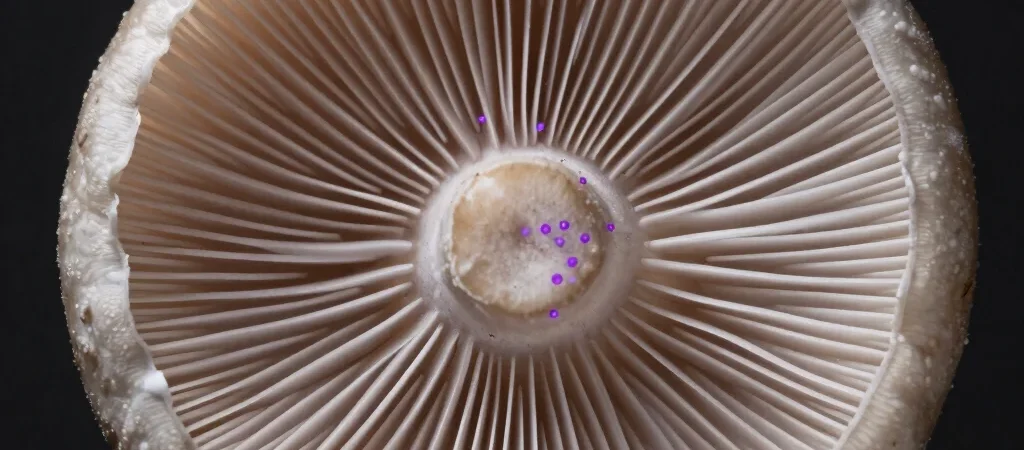
Standing still on a forest floor, a mushroom looks entirely passive, waiting for a passing breeze to sweep away its microscopic offspring. Yet microscopic observations reveal an active engineering marvel happening under the cap. Fungi manipulate local humidity to generate miniature electrostatic charges, launching billions of spores into the air even when the surrounding forest atmosphere is completely still.
Creating Microclimates Beneath the Cap
A mushroom releases water vapor into the tight spaces between its gills, cooling the immediate air through evaporation. This temperature drop creates a subtle localized breeze that flows downward and outward from the cap. This self-generated air current gives spores the initial push they need to escape the physical boundary of the mushroom structure.
The Electrostatic Catapult Mechanism
At the tip of each spore, two tiny drops of fluid condense from the surrounding humid air. When these droplets merge, their surface tension releases kinetic energy in a microsecond burst known as Buller's drop mechanism. This rapid shift accelerates the spore outward with g-forces vastly superior to a space shuttle launch.
Riding Electrical Currents Through the Atmosphere
Once airborne, the tiny spores carry a faint electrostatic charge acquired during release. This positive charge interacts with the natural electric field present above the soil, helping the spores repel each other rather than clumping together. As a result, the fungal spores float farther and spread evenly across distant soil patches.